2010年11月9日火曜日

Rainy Day

It is one of those miserably wet, dark days, raining steadily from a leaden sky. Yesterday was just the same. And the forecast for the next few days is for more rain. Most of the leaves are off the trees and everything looks damply depressing. So, here is a picture from my garden this summer to cheer us all up.


This one is a dahlia from a mixed 'bargain' pack, so that is all I know about it.


2010年11月8日月曜日

Busy Mother

No, I don't mean me. My daughter is grown up and living in Scotland and my husband and I thoroughly enjoy our empty nest.


Here she is in front of my dolls house with baby, toddler and dog.

I really enjoyed knitting miniature clothes and accessories. I used patterns from Farthing Patterns and Period Miniature Patterns.

Mostly I used number 80 lace crochet/tatting thread, not least because that was what I had around.

For anyone wondering, it is not as tricky to knit at these small scales as you would think. I used one of the magnifiers embroiderers use for fine work. There is a cord round your neck and then the base sits on your chest. I found this easier than strong spectacles because you have to take them off to check the pattern.

The little dog was made to order for me by a lady whose name I'm afraid to say I have now forgotten. He was the most expensive item in the dolls house, but is beautifully made, every hair stuck on individually.


2010年11月7日日曜日

The Romance Shawl


This is a pattern by Dorothy Siemens of Fiddlesticks Knitting entitled The Romance Shawl.

Her pattern is for a triangular shawl, but as I prefer square shawls I made it square. This is very easy with any shawl that starts with a small number of stitches and increases to form the triangle. In this case the design is basically two triangles forming a larger triangle. If you work four triangles you get a square.

All you have to do is identify the outside edge stitches and omit them. Instead you take the part between the original two triangles,  in this case, where the double row of  yarn overs form a line,  and work it four times.

 The other point is that the original triangle was worked back and forth, but the square is worked in the round. This means that every round is now a right side round. In this case the shawl is on a stocking stitch background so the instructions tell you to knit alternate, ie. wrong side rows, in purl. But for a square there are no wrong side rows, so the odd-numbered rows need to be knitted. 

This pattern has an interesting double border, so that the red border and the blue border, which in the photograph look like merely a change of colour, are actually two separate borders knitted one on top of the other.

I was really attracted by this idea but this was the shawl that made me decide that I prefer borders knitted on at right angles. This is merely a matter of preference, I just happen to prefer the way they look.

I must say how much I appreciate the large print of  Fiddlesticks Knitting patterns and the large clear charts.

 I am partially sighted so am very aware of these things and would say that this company and Heirloom Knitting are both very good in this respect. In the case of other companies I am often put off because I would need to get the charts enlarged before I could start knitting, and being housebound these days that means asking someone to do it for me.


2010年11月5日金曜日

Double Knitting

For those who haven't yet come across this handy little technique, it lets you knit something, in the round, on two needles. While it is not going to challenge the use of circular needles, it is very useful for those little things that are a pain to knit on double pointed needles, legs for soft toys, small bags for ipods and phones, or in this case a little bag to hold my tatting.


This one is knitted in a 4ply sock yarn as I had some left over from something or other.

What you do is, first, cast on an even number of stitches.
Then you (knit one slip one) across the row. At this point you have knitted half your stitches and therefore worked half the round.
Now, work back, knitting the slipped stitches and slipping the knit stitches you worked before. One round complete.
Work about a centimetre.

You will notice that the purl side of the knitting is on the outside. Don't worry, you will be able to turn it inside out later!
At this point, gently pull the back and front of the knitting apart and you should be able to tell that your knitting is in two layers with an open centre.

A word of warning! If you knit a stitch you should have slipped, at any point!, your knitting will stick together and you will not have a hollow tube!

Apparently, when my mother was at school, about 1930, there was a fashion, at least at her school, for double knitted scarves. She knitted, and knitted, and it seemed to go on for ever. Then came the day when she should have been able to pull her scarf into a tube, instead of a flat piece of knitting. But, oh dear, it was caught together in lots of places, where she'd done the wrong thing. She was devastated and never felt kindly about knitting again!

There are techniques for increasing and decreasing, but I find them a bit of a nuisance, so I feel that this technique is most useful for a straight sided piece.

When I had worked the body of the bag, I slipped one set of stitches onto a needle and the other set onto a holder. This is the crunch point when you find out if you have really produced a bag or just a stuck-together-somewhere piece! If you want the knit side out, you can turn your work inside out at this point.

Now you can work each side of the top separately to form the hem and the cord casing.
In this case I worked stocking stitch to the top, put in a purl turning row, and worked back down, forming a double thickness hem which I stitched down in two places to form the cord casing. But there are any number of alternatives I could have used.


2010年11月4日木曜日

Tatted Bookmarks


I start each morning, after I've taken the ever-increasing number of medications the doctor has me on, with four Bible readings. For that purpose I have four bookmarks, and my husband reminded me the other day that I should photograph them.

So here they are. The two on the left are from Tatted Bookmarks by Lene Bjorn. I particularly like her dimpled ring pattern and have made and given it away several times. The Seahorse is another of my favourite patterns. It is by Mark Myers and can be found in Animal Bookmarks by Diana Stevens. I've also made this one in blues and greens as a gift for a friend. The one second from the right is one of Mary Konior's patterns, from Tatting with Visual Patterns, a book that was a godsend to me back in my early days of tatting when the Dover books, with their complex written patterns, were about all I could get!


 And here is the Bible they keep my places in. I'm partially sighted and need a large print Bible. For some reason, although you can buy really attractive leather-covered Bibles in normal print, the ones in large print always seem to come in institutional plasticised covers that, at any rate to me, feel most unpleasantly sticky, even when brand new! So I took my Bible and covered it in some leather. It was an upholstery leather remnant that I had bought to recover my footstool. I had just enough left over to cover the Bible as well.

For anyone interested it is really easy. Smear the book cover well with craft glue and smooth the leather on to it. Use a ruler to push the leather into the ditch beside the spine. Trim the leather leaving a generous turn over all round. Cut the extra leather at both sides of the spine so you have a bit like a bookmark hanging down. Then, assuming this is a hardback that you are covering, push the strip into the gap between the spine and the pages, glueing it into place. Then you can glue the rest of the extra leather inside the cover, mitring the corners. Glue the blank first and last pages in place to hide the leather turn-over, and leave to dry. The cross is simply cardboard, covered in a scrap of left-over pig-skin, and stuck on.

(Apologies to any vegetarians reading this, but after all, the method would work equally well with imitation leather or suede.)


2010年11月3日水曜日

Japanese acers


The Japanese maples at the end of our garden are particularly colourful this year. They are about twenty years old now and I actually grew them from seed. We had a bigger garden and a greenhouse back then, but when we moved  a few years later we brought them with us. They grow surprisingly quickly, especially after the first ten years, and they are not difficult to grow from seed. 


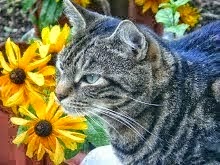
And here is Ginger demanding that I take his photo since I've got the camera out.


2010年11月2日火曜日

Muriel Shawl


I've just finished my latest shawl. This is Muriel Shawl by Julie Dexter from The Knitter Issue 21. It is worked almost exactly as described in the magazine with the exception of a slight alteration to the edging. It is in Manos del Uruguay Lace yarn, a pleasure to knit with and unbelievably light and warm when finished.


I don't normally make triangular shawls as I prefer a double layer of shawl on my shoulders, which means a square or circular shawl folded  in two. But I was so intrigued by the construction of this one with its short row garter stitch centre that I just had to try it. And I'm so glad I did! It is huge, I tend to find most shawls a bit small since I wear them for warmth and comfort rather than as a fashion statement, but this one is big enough to be really comfortable. 


Here it is off the blocking board and ready to wear!